

My goal in this project was to make an early medieval-style hood from hand woven cloth. Most of the information I used for the cloth structure and patterning of the hood comes from Woven into the Earth by Else Østergård and the companion book, Medieval Garments Reconstructed by Lilli Fransen, Anna Nørgaard, Else Østergård .
The cloth was woven using Möbelåtta yarn from Borgs Vävgarner in Vittsjö, Sweden. It is an s spun, z plied yarn, which is not consistent with the single-ply yarn that was typically used in the greenland finds, however it is a stronger, smoother yarn than most yarns commercially produced in North America and is therefore closer in texture to the yarns which would have been used in medieval Scandinavia.
Dyeing: The weft yarn was dyed with weld and mordanted with iron to produce a light green. After several hours of simmering, the colour produced by the weld alone was weaker than desired and so some fustic extract was added to the dye bath to intensify the colour. The warp for this cloth was left un-dyed.
Weaving the cloth: The cloth has a 2/2 twill structure, the weave structure found most commonly in the Greenland garments. 2/2 twills are also commonly found in other examples of medieval European cloth so it was a good structure to go with. The threads were spaced at 20 ends per inch (approx. 7 ends per centimetre), this falls within the range of densities found in historic examples although it is on the slightly coarser side.
Sewing the hood: All of the original Greenland hoods are believed to have had liripipes and date to around the 15th century. Inspired by 12th century depictions of hoods, I decided to do without the liripipe. This turned out to be a very good decision as, because I was only able to weave about 1.25 m of cloth, it would have been a stretch to cut a liripipe out of what little fabric I had left over. As it was, I had to be creative with the cutting of the hood which meant cutting it perpendicular to the grain, the end result being that the weft of the cloth actually runs vertically on the finished hood. Since the weave is a balanced 2/2 twill, and the warp and weft are of exactly the same quality and twist direction, this doesn’t seem to have had an adverse effect on the drape of the hood.
This was the first time I had used construction methods described in Woven Into the Earth. I stitched the seams from the front side of the cloth, having initially folded the seam allowance and pinned the cloth. The seams were finished by laying two pieces of yarn along the raw edge of the cloth and whipstitching around both the cloth and the yarn. All seams were sewn with leftover warp ends. Stab stitching around the outer folded edge added simple decoration and reinforced the seams. The yarn used for the stab stitching is hand-spun single ply wool, dyed with madder.
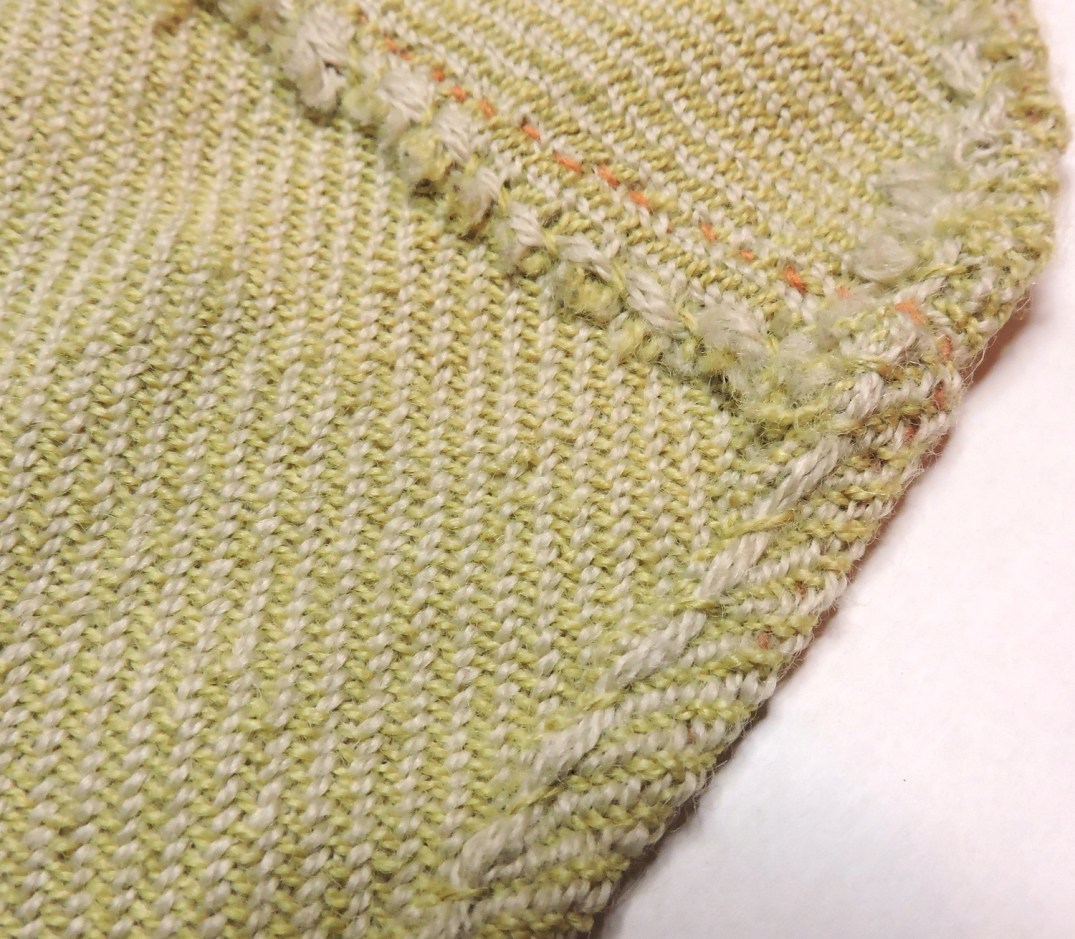

Conclusions: I have been wearing the hood to medieval events for about two years and (in addition to being quite warm) it has held up very well to being shoved in bags, pulled roughly over my head on a cold evening and all of the general wear-and tear and functional garment must endure. At this point the only noticeable sign of wear are a few stray threads which have worked their way free of stitching, this is slightly unappealing aesthetically but has not resulted in any holes or tears in the hood. It may be that my seams were too narrow or my stitches to loose in certain spots but I can also at least partially attribute this slight fraying to just how springy the yarn used is, as it was a struggle keeping the edges from fraying even when first sewing them.

References
Crowfoot, Elisabeth, Frances Pritchard, Kay Staniland, Edwin Baker, and Christina Unwin. Textiles and Clothing C.1150-c.1450. Woodbridge: Boydell, 2006. Print.
Fransen, Lilli, Anna Nørgaard, Else Østergård, and Shelly Nordtorp-Madson.Medieval Garments Reconstructed: Norse Clothing Patterns. Aarhus: Aarhus UP, 2011. Print.
Østergård, Else. Woven into the Earth: Textiles from Norse Greenland. Aarhus: Aarhus UP, 2004. Print.
 Greta Pepper